Epoxy Flooring in Killeen, TX

Garage floors, polished concrete and commercial coatings, specified from what your slab is actually sitting on.

Killeen Epoxy Flooring has spent more than 20 years putting resinous floors down on Killeen slabs — epoxy garage floors, polished concrete, polyaspartic coatings, concrete resurfacing and commercial epoxy flooring across Killeen and the rest of Bell County. We coat garages, shop floors, kitchens, warehouses and hangar bays, and we do the grinding, the moisture testing and the crack detailing ourselves rather than subbing the hard half out.

The part that decides whether a floor lasts here happens before any product is opened. The ground under this city is San Saba clay, a smectitic Vertisol running about 50 percent clay with a plasticity index of 40, and it swells and shrinks with the season. A coating is a film a few thousandths of an inch thick and it follows whatever the slab does. So we look at what your slab is sitting on, what it has already been through and how it is moving now, and we quote from that rather than from a square-foot rate.

That approach fits three different buyers in this city and we are straight with each of them. A homeowner wants a floor they will be looking at for a decade, while a landlord turning a rental house wants a surface that survives a move-out and is ready on a date. A facility manager wants a specification that passes an inspection. Those are different jobs, and pretending one product answers all three is how floors come back.

Get Your Free Quote

Fast response • No obligation

So we can reach you about your request.

So we can send you a confirmation after you submit this inquiry form.

  • 20+ Years Experience
  • Insured & City Registered
  • Free Estimates

What we do

Our Services

Epoxy flooring and concrete coatings in Killeen, Texas

Epoxy Garage Floor

Full-build epoxy garage floors in Killeen, TX, specified from your slab's own moisture, cracks and construction.

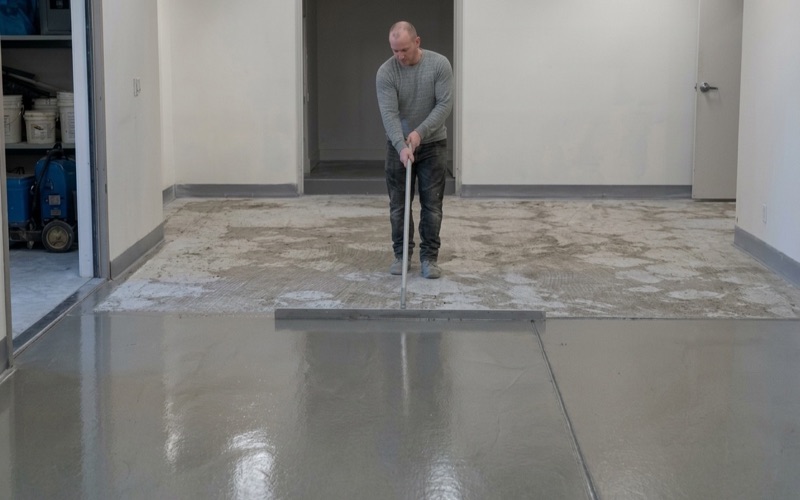
A gray epoxy base coat being squeegeed across a Killeen garage slab, with a clean wet edge across the bay.

Polished Concrete Flooring

Mechanically ground and densified polished concrete for Killeen warehouses, showrooms and homes, with no film to debond.

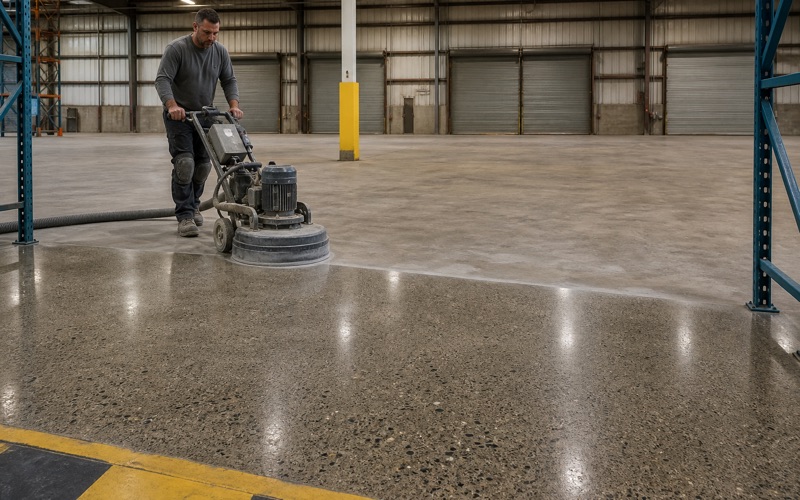
A warehouse slab in Killeen mid-polish, one half refined to a satin finish and the other still unworked.

Concrete Resurfacing

Bonded overlays that rebuild a sound wearing surface on spalled or delaminated Killeen slabs, with working cracks detailed as joints.

A cement overlay being screeded over a spalled slab in Killeen, with the existing control joint carried through the new surface.

Polyaspartic Floor Coating

Fast-cure, UV-stable polyaspartic floor coatings for Killeen garages, bays and exterior slabs, mixed to the working time the day actually allows.

A clear polyaspartic wear coat being applied in a narrow working section over a flake floor in a Killeen garage.

Commercial Epoxy Flooring

Commercial epoxy floors for Killeen kitchens, warehouses, service bays and hangars, specified to the duty and phased around your operating hours.

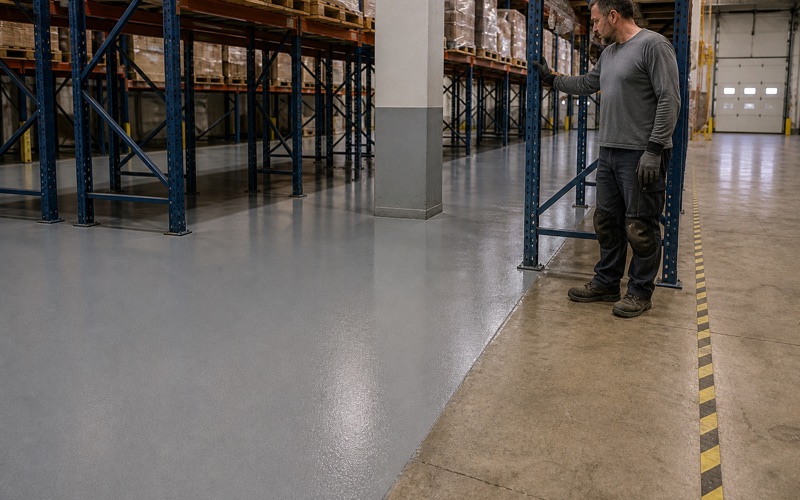
A Killeen warehouse floor coated one bay at a time around live racking, the division following a filled saw-cut joint.

Pool Deck Resurfacing

UV-stable, slip-graded pool deck resurfacing for Killeen decks, specified for wet feet, hot sun and chlorinated splash-out.

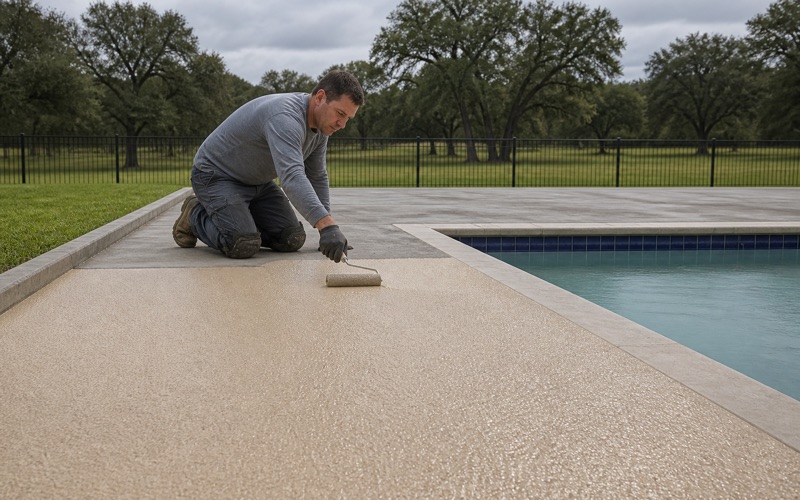
A textured pool deck coating in Killeen being laid to the coping edge, the finished half pale and visibly non-slip.

Concrete Grinding

Diamond grinding and shot blasting that opens a slab properly, so the coating going over it bonds instead of peeling.

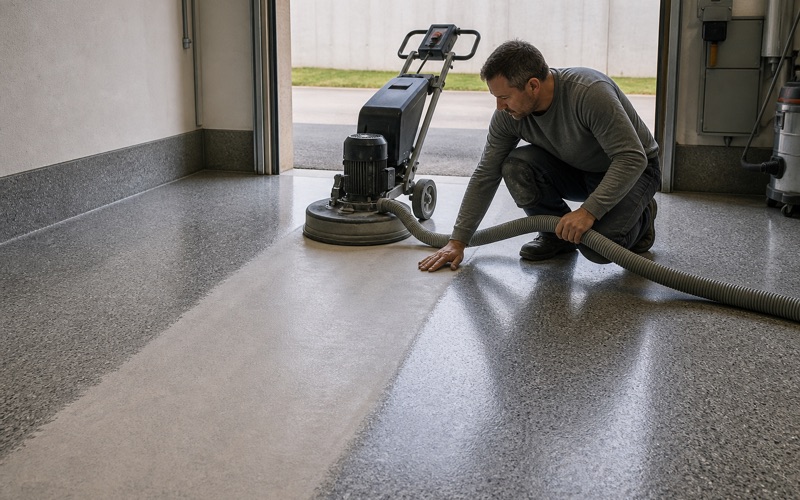
A garage slab in Killeen being diamond ground with a shrouded machine, the opened profile pale against sealed concrete.

Metallic Epoxy Floor

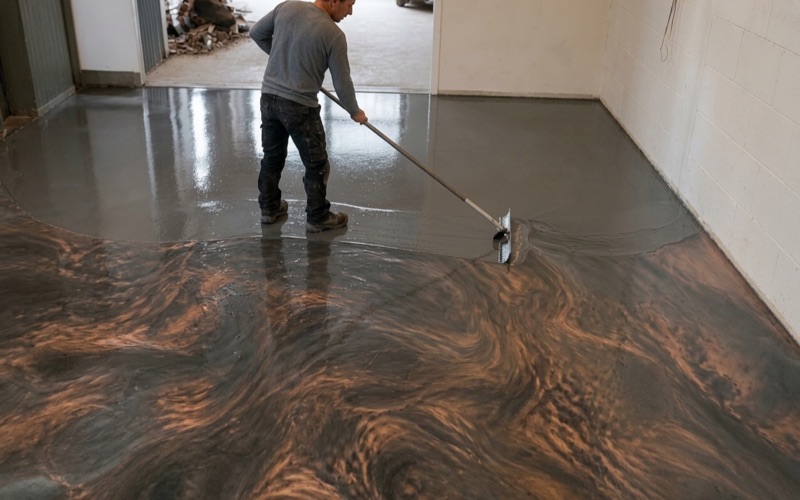
Metallic epoxy floors with pigment worked wet for depth and marbling, sealed under a clear coat built for the room's real duty.

A pewter and bronze metallic epoxy floor in Killeen being worked wet, the marbling visibly still moving under the squeegee.

Flake Epoxy Floor

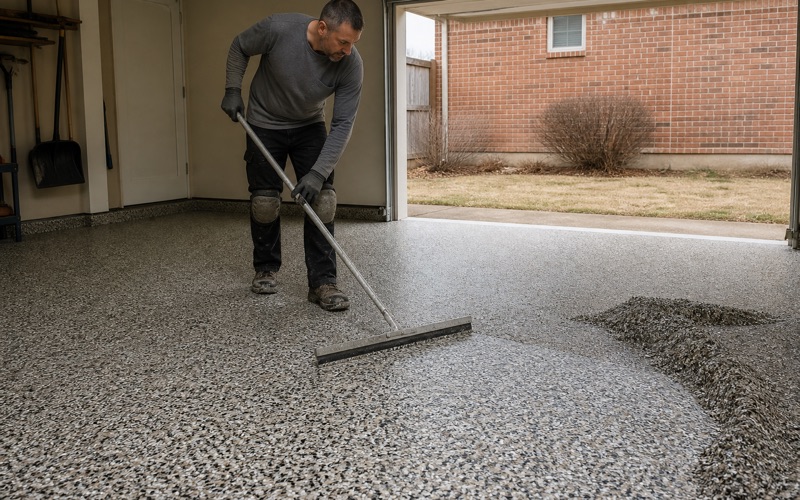
Decorative vinyl chip floors for Killeen garages and shops, with chip size, blend, base color and broadcast coverage settled before any resin goes down.

Surplus flake being scraped back on a Killeen garage floor, the chip pattern reading flat and even behind the blade.

Epoxy Floor Repair

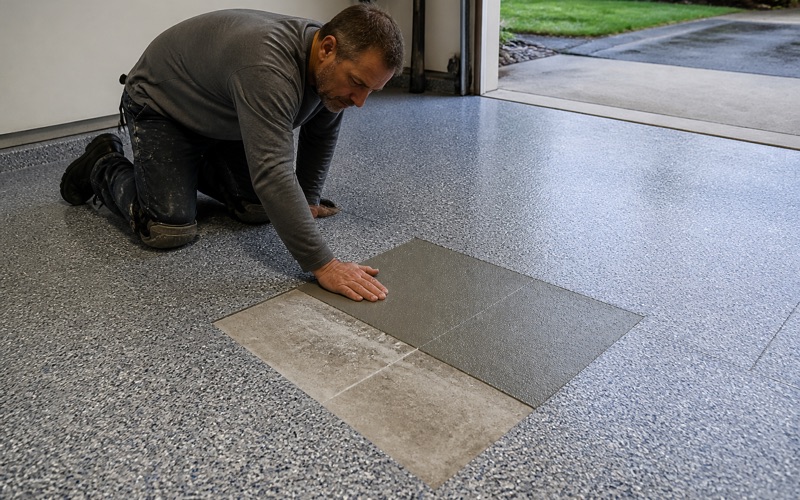
Diagnosis first: peel pattern, slab moisture testing and adhesion mapping decide whether a failed floor gets a recoat, a partial cut-back or full removal.

A square repair cut into a sound flake floor in Killeen, its edges saw-cut clean and the joint carried through.

Concrete Driveway Coating

Exterior slabs specified for what they actually take: UV, hot tires, turning and truck loads, moving joints and freeze-thaw, not a garage system left outside.

What Stands Behind the Work

Two Decades on Central Texas Slabs

More than 20 years of this work in one climate and one soil region means we have already seen what fails here and when. That is why moisture testing and crack detailing are line items in our scope rather than upsells added after a floor blisters.

Registered With the City of Killeen

Texas licenses no flooring, coatings or painting contractor, so a license number is not something any honest company in this trade can show you. What we can show is our City of Killeen general construction registration, general liability cover, workers’ compensation and a Texas sales and use tax permit — all of which you can check.

A Proposal You Can Audit Afterward

Every proposal names the product, the system build and the finished mil thickness. That turns a quote into something measurable: what was promised can be compared against what actually went down, which a square-foot price alone never allows.

Why Choose Killeen Epoxy Flooring

Slab Read Before Quoting

Every quote follows a look at the actual slab rather than a phone description, because ground with a plasticity index of 40 puts cracks in floors that a photograph does not show, so you get a scope written for your concrete rather than a rate card that assumes everyone’s slab is the same.

Dew Point, Not Air Temperature

No crew here starts on slab temperature guesswork. We measure the slab surface against the dew point and start when the spread is safe, which in a Killeen August usually means mid-morning rather than first light, so a coating bonds instead of blushing on a floor that looked dry and was actively condensing.

Movement Named Before It Is Sold

Never a promise that a coating stops slab movement, because nothing a mil thick can. A crack over seasonally moving ground is routed and filled as a working joint and you are told up front it can telegraph again, rather than being sold a rigid patch that splits in the first dry summer.

Exclusions Read Out First

Every warranty exclusion is read to you before the job is sold, substrate movement and moisture first among them. A long warranty with unread exclusions is worth less than a short one you understand, and over ground that moves this much the exclusions are the part that decides whether it ever pays out.

Turnover Dates Quoted Honestly

On a rental turnover the handover date is part of the deliverable, so we quote the real return-to-service and pick a system that fits the lease. That matters in a city where half the houses are rented and a landlord is scheduling around a vacancy, rather than discovering a recoat window after the tenant has arrived.

Garage Floors, and the Ground Under Them

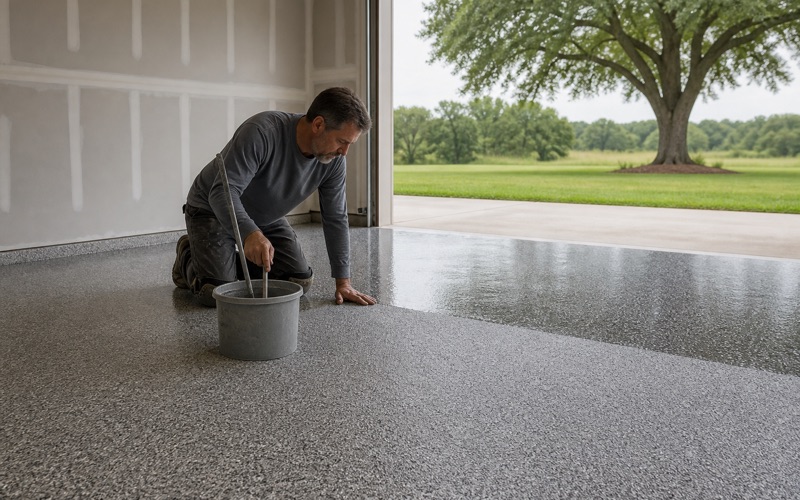
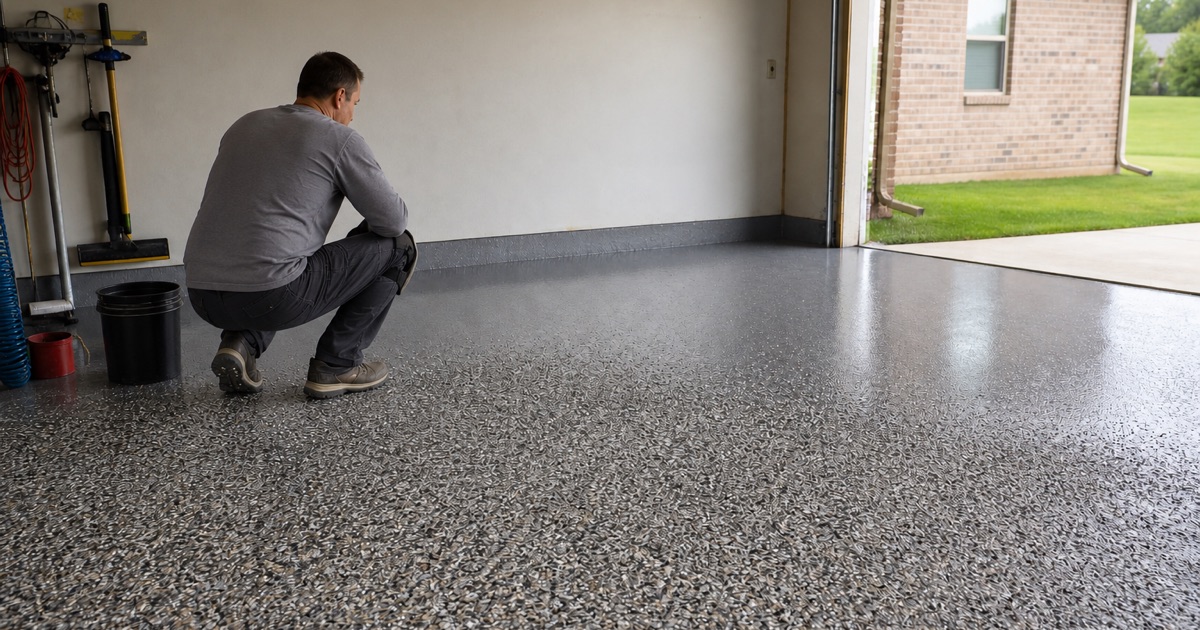
A finished tan and gray flake epoxy garage floor in Killeen with the roll-up door open, a worker crouched at the threshold.

What an Epoxy Garage Floor Job Actually Involves

A garage floor coating is a system, not a paint: mechanical preparation, crack and joint detailing, a primer chosen for the slab’s moisture condition, a build coat and a wear coat. We walk the slab, test it, grind it open, detail what is moving and then coat it. Knowing the sequence tells you what a suspiciously cheap quote has left out.

Finding Out What Your Slab Sits On

Soil is not uniform across this city, and the map unit under one street is not the one under the next. We identify the soil beneath the address and read it against what the slab is already telling us. That decides the crack detail and the primer far more than the color you pick.

High-Plasticity Clay and What It Does to a Slab

San Saba clay carries a plasticity index of 40 and a linear extensibility around 10 percent, which is a very high shrink-swell rating. Soil like that takes on water and expands, then dries and contracts, and the slab on it moves too. We specify for a floor that will move rather than one we pretend is static.

Reading the Cracks You Already Have

A crack that has finished moving and a crack that opens every dry summer look identical on a Tuesday. We read crack width, edge condition and pattern, and where it matters we check across a season rather than guessing. A settled crack can be filled and closed permanently; a working one cannot.

Why a Moving Crack Becomes a Joint

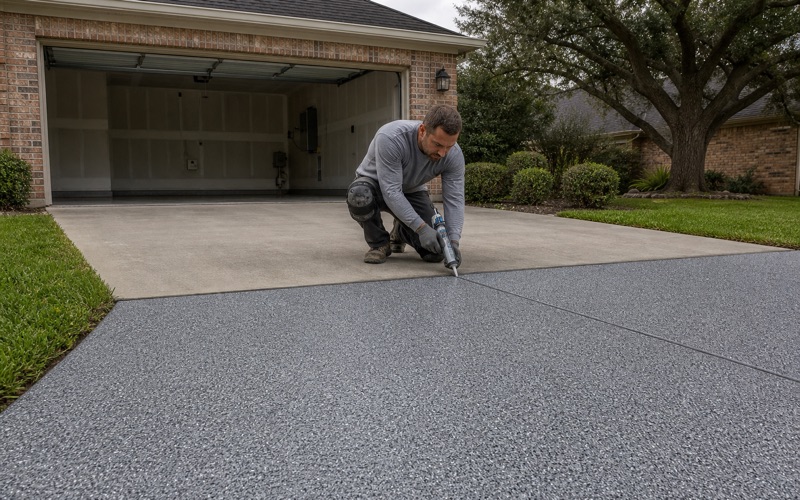
A working crack gets routed out and filled with a semi-rigid polyurea joint filler, then honored through the coating instead of being skimmed over. Filling a live crack hard and coating across it guarantees the coating splits along the same line. Treating it as a joint means it stays serviceable and can be maintained.

Moisture Testing Before Anything Is Ordered

Moisture vapor driving up through a slab is the most common cause of epoxy adhesion failure on residential concrete. We test with calcium chloride to ASTM F1869 or in-situ relative humidity probes to ASTM F2170, read against ASTM F710 thresholds. A dry-looking floor is not a moisture reading, and a slab poured without a vapor retarder rarely is dry.

Grinding the Slab Open

Concrete is coated on profile, not on cleanliness. We grind or shot blast to an ICRI CSP profile appropriate to the system, using diamond tooling matched to the concrete — and hard concrete takes a soft bond, which is the opposite of what most people assume. We do not acid etch and we do not coat over an existing sealer.

Post-Tensioned Slabs and the Cables Inside Them

Post-tension slabs became common in Texas after about 1980, and roughly three quarters of this city’s housing was built in or after that year. Cutting, coring or driving an anchor into one risks severing a tendon, which is a structural repair rather than a floor repair. We establish slab type before anything penetrates it.

Emptying a Garage That Has Held Twenty Years of Storage

A garage floor cannot be prepared around shelving, a freezer and a decade of boxes, so the bay has to come out before the grinder goes in. We agree in writing who moves what and where it goes. That conversation before the job avoids the argument on the morning of it.

The Threshold, the Step-Down and the Edges

Where a floor stops is where it looks cheap or looks finished. We detail the overhead door threshold, any step-down to the house and the perimeter edge deliberately, terminating the coating cleanly rather than feathering it out. Those few feet are what a visitor’s eye lands on first.

When a Floor Has Already Failed

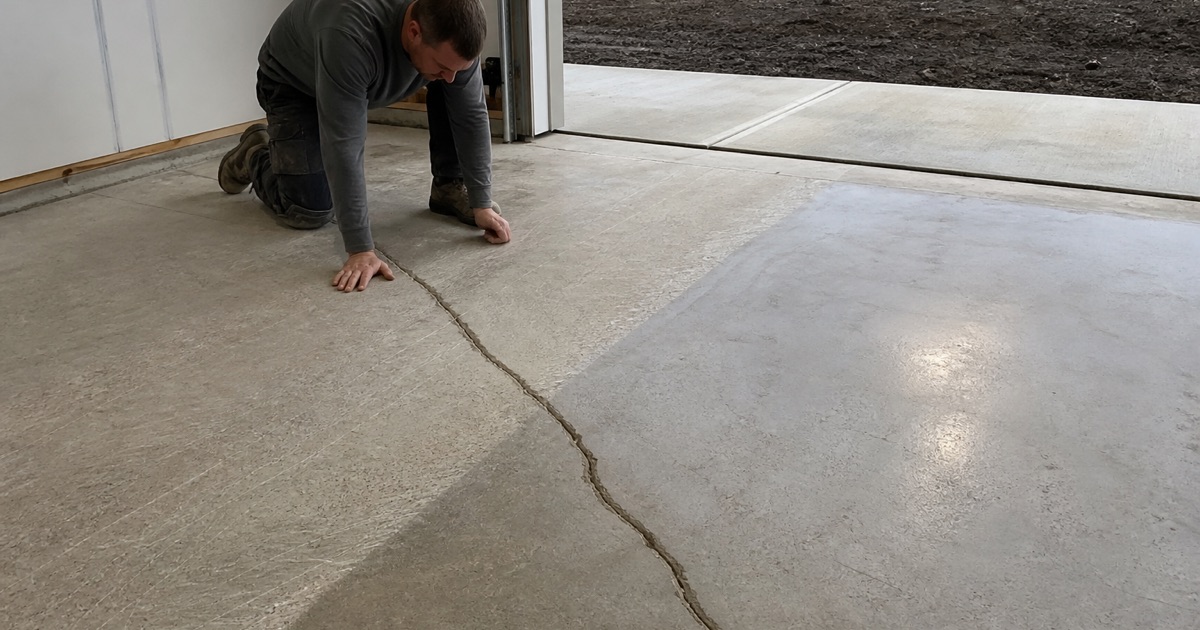
A garage slab in Killeen half ground open, with a crack routed out into a clean channel ready for a flexible joint filler.

Reading the Peel Pattern on a Failed Coating

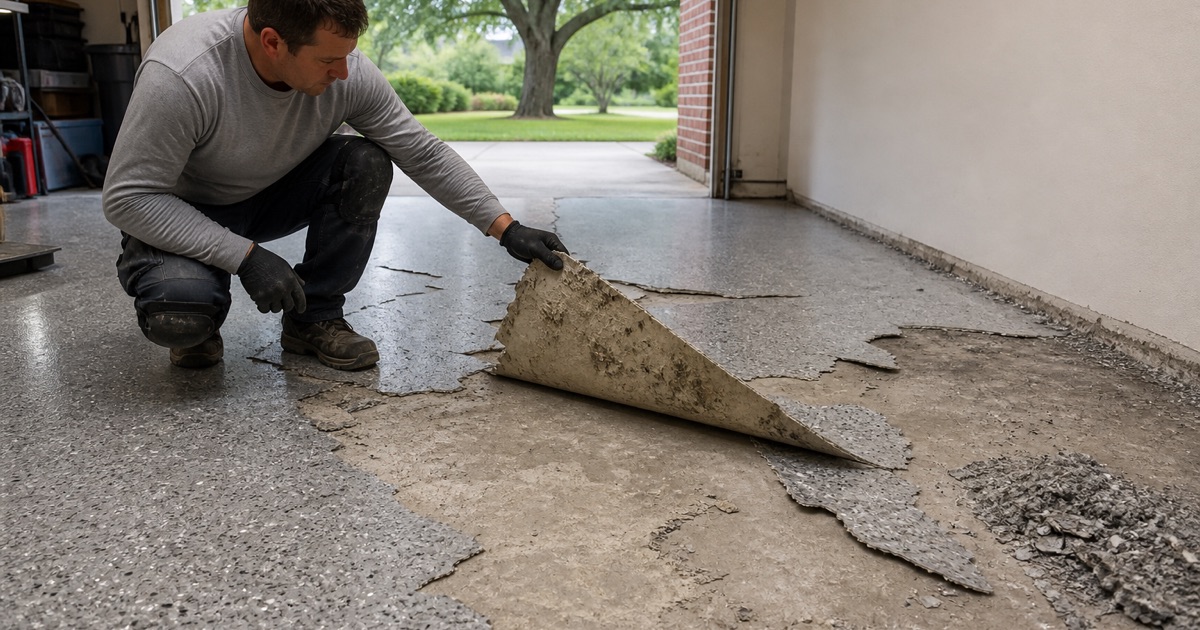
How a coating let go says why. Sheets lifting cleanly with the slab’s own laitance on the back point to preparation; blistering from underneath points to moisture; edge-in peeling points to a contaminated perimeter. We diagnose before quoting, because a recoat over an undiagnosed cause fails the same way.

Bubbles, Blisters and the Reading Underneath

Osmotic blistering is a moisture problem wearing a coating problem’s clothes. We open a blister, look at what is behind it and put a meter on the slab rather than assuming a bad batch. Where vapor drive is the cause, the fix is a moisture-mitigation primer, not a heavier topcoat.

Hot Tire Pickup and Why Some Coatings Lift

A warm tire plasticizes a thin or under-cured film and lifts it when the car is moved, taking a patch of coating with it. Full-build 100 percent solids epoxy with a polyaspartic wear coat resists it; a thin single-coat product does not. This is the single most common complaint on a cheap garage floor.

Recoating Over a Floor Bonded in Places

A floor that is sound in places and loose in others is the hardest recoat there is, because a new coating is only as good as what it sits on. We test adhesion across the slab and remove everything that fails, rather than coating over a bond that is already letting go and calling it preparation.

Taking an Old Coating Off Without Wrecking the Slab

Coating removal is its own operation. PCD tooling takes a stubborn film off fast and leaves an aggressive profile behind, so it is followed by a finer diamond pass to bring the surface back to a coatable profile. Removing a coating and gouging the slab underneath simply moves the problem.

The Crack That Comes Back Every Time

A crack reappearing through successive floors is not a filler failure, it is a slab that is still moving. We stop trying to make it disappear and detail it as a joint that is allowed to move, which keeps it serviceable. A crack you can maintain beats a crack you keep re-hiding.

Chalking, Yellowing and Ordinary Wear

Chalking and ambering are typically a topcoat’s ultraviolet response rather than a bond failure, so a floor can look tired while being perfectly sound. We check adhesion before recommending anything. Where the film is intact, a wear-coat refresh costs a fraction of a strip and recoat.

Concrete Resurfacing When the Slab Itself Has Gone

Where the concrete surface has spalled or delaminated, no coating fixes it, because the surface it would bond to is the part that failed. Concrete resurfacing rebuilds a sound wearing surface first, and the coating goes over that. Coating a delaminating slab buys a few months.

What a Coating Warranty Usually Excludes

Substrate movement and moisture are excluded from most coating warranties in this trade, which over ground with this plasticity index is precisely the failure most likely to happen. We read our exclusions to you before you buy. A fifteen-year warranty that excludes the two likely failure modes is a shorter warranty than it looks.

Color, Flake and Finish

A failed epoxy garage floor in Killeen lifting in sheets, a worker turning back one piece to read its underside.

Vinyl Flake Floors and How the Blend Reads

Flake is broadcast into a wet base coat to refusal, then scraped and sealed, and the chip size and blend decide whether the floor reads busy or calm. Larger chips at a heavier broadcast rate hide more; a finer blend reads tighter. We show samples at floor scale rather than in a palm, because a two-inch chip lies about how it looks across a bay.

Metallic Epoxy and What the Marbling Takes

Metallic pigment is moved through a 100 percent solids epoxy while it is wet, and the marbling comes from how it is worked rather than from the product. It is a technique-dependent finish and no two floors match exactly. We say that plainly beforehand, because it is the finish most likely to disappoint someone expecting a printed pattern.

Polished Concrete and the Aggregate You Expose

Polished concrete is ground and refined in stages, and how deep the first cut goes decides whether you see cream, salt-and-pepper or full aggregate. A lithium silicate densifier hardens the surface between passes. We agree the exposure level before starting, because it is set in the first cut and cannot be walked back.

Gloss, Satin and Matte in a Working Garage

Gloss looks best on the day and shows every tire mark and dust film afterward; satin hides ordinary use; matte hides most of it and reads flat. In a bay that gets used daily, satin is usually the honest recommendation. We show all three under the same light before you choose.

Quartz Broadcast Where Slip Resistance Has to Arrive Too

Quartz aggregate broadcast builds a heavier, more textured floor that carries color and slip resistance in one system. It suits wet areas and commercial floors where a coefficient of friction has to be met rather than hoped for. The trade-off is a surface that cleans differently from a smooth coating, and we walk through that.

Solid Color Coatings and When Plain Wins

A single pigmented coat with a clear wear layer is the cleanest look available and the easiest to touch in later. On a shop floor where equipment is the subject, or under a specification that wants a plain surface, it is the right answer. Not every floor is improved by a pattern.

Matching a Floor to the Room It Serves

A showroom, a working shop and a room people sit in want different things from the same trade. We match gloss, color and texture to how the space is used and lit rather than to a sample card. A finish chosen under fluorescent light in a warehouse reads differently in a daylit room.

Saw-Cut Lines, Borders and Inlaid Logos

Saw-cut detailing, contrasting borders and inlaid logos are set out before any coating goes down, because they are cut into the substrate and cannot be added afterward. We lay them out on the slab and agree them with you standing on it. It is the cheapest stage at which to change your mind.

Stained and Dyed Concrete as the Other Option

Where you want the concrete to still read as concrete, a stain or dye with a sealer keeps the slab’s own character and costs less than a full build. It offers far less chemical and abrasion protection than a coating. We tell you which one your floor’s use actually calls for.

Shop Floors, Plants and Commercial Kitchens

Flake broadcast in progress on a Killeen garage floor, an arc of gray and tan chip in the air above the wet base coat.

Commercial Epoxy Flooring and How the Job Differs

A commercial floor is governed by the schedule and the specification rather than by taste. Return-to-service, odor and re-occupancy, phasing around operations and a documented system build all become part of the scope. We quote those explicitly, because on a commercial job the date and the spec are what is being bought.

Warehouse Floors Under Forklift Traffic and Rack Loads

Forklift wheels concentrate load and point-load rack feet punch through a thin film, so warehouse floors need build thickness and joint detailing more than they need gloss. We specify to the traffic and detail the control joints to survive it. A warehouse coating fails at its joints long before it fails in the field.

Auto, Truck and Tire Service Bays

Service bays live with oil, coolant, brake fluid and hot tires, which is a chemical-resistance question and a hot tire pickup question at once. A full-build epoxy with a polyaspartic or polyurea wear coat handles both. We also detail drains and floor penetrations properly, since that is where a bay floor usually lets go.

Commercial Kitchen Floors Under the Texas Rules

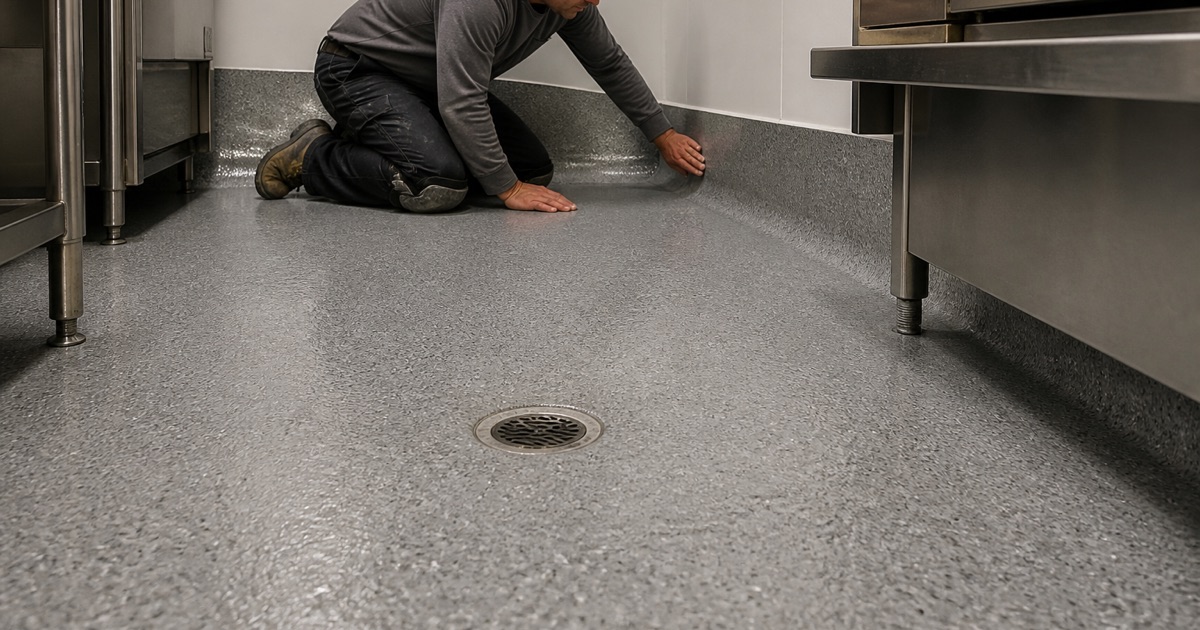
Texas adopts the FDA Food Code by reference through 25 TAC Chapter 228, and section 6-101.11(A) requires a floor that is smooth, durable and easily cleanable, nonabsorbent where it is wet. Section 6-201.13 requires the floor and wall juncture to be coved and closed. We build an integral coved base rather than a caulked joint, because that is what the rule asks for.

The Antislip Exception the Food Code Writes Itself

Operators are often told a broadcast texture conflicts with the requirement for a smooth floor. It does not: section 6-201.11 carries an express carve-out for antislip floor coverings or applications used for safety reasons. We specify the texture the kitchen needs and cite the exception that permits it, rather than choosing between a slip hazard and a compliance problem.

Urethane Cement Where Epoxy Would Not Survive

Hot washdown, steam and thermal shock take an epoxy off a slab regardless of how well it was installed, because the coating and the concrete expand at different rates. Urethane cement is formulated for that duty and tolerates it. In a kitchen or a processing area with hot water on the floor daily, it is the right system.

ESD and Static-Dissipative Floors

Electronics assembly and some chemical handling areas need a floor within a specified electrical resistance range, achieved with a conductive layer and grounding rather than with an additive alone. We install to the resistance range the specification names and document the result. Guessing at a static-control floor defeats the purpose of having one.

Chemical-Resistant and Secondary Containment Floors

Specialty chemical manufacturing needs floors that resist specific reagents and, in containment areas, hold a spill rather than pass it. That means a chemically appropriate resin, coved containment details and correctly treated penetrations. We specify against the actual chemicals on site instead of against a general chemical-resistance claim.

Aircraft Hangar and Maintenance Floors

Hangar floors combine large uninterrupted areas, fuel and hydraulic exposure, and point loads from jacks and tugs. They also need to be coated in phases around aircraft that cannot simply be moved out for a week. We plan the phasing first, then specify a system whose recoat window fits it.

Medical, Dental and Veterinary Floors

Clinical floors have to be seamless and cleanable, with coved edges and no crevices for anything to sit in. We install a monolithic surface with detailed junctions and a topcoat compatible with the disinfectants actually in use. A floor that cannot take the cleaning regime is a floor that fails at the edges first.

Working Around a Business That Cannot Close

Most commercial floors go in around an operating business, which means phasing, containment and honest cure times. We sequence the work in sections and tell you what each section costs in downtime before starting. A fast product with a long recoat window can take longer overall than a slower one.

Areas We Serve

Killeen Epoxy Flooring provides epoxy flooring throughout the greater Killeen area, with the same crews and the same standards on every job.

Good to know

Frequently Asked Questions

How much does an epoxy garage floor cost in Killeen?

Price follows the slab's condition and the system, not the square footage alone. A sound post-2000 slab needing ordinary preparation sits at the low end; an older slab with a failed coating, moving cracks to detail and a moisture problem to mitigate costs materially more, because preparation is most of the labor. We quote after looking at the slab, and the proposal names the product, the system build and the mil thickness.

Are you licensed and insured?

Texas does not license flooring, coatings, painting or general contractors, so any company here advertising itself as a licensed floor coating contractor is claiming something that does not exist. We carry general liability cover and workers' compensation, hold a Texas sales and use tax permit, and are registered with the City of Killeen for general construction. All of those are verifiable, which a license number in this trade would not be.

How long before I can park on the floor?

Foot traffic is typically the day after the final coat and vehicle traffic several days after, but the honest answer depends on the system and the slab temperature during cure. Heat shortens pot life and the recoat window while cold lengthens everything, so a floor coated in August and one coated in February do not follow the same schedule. We quote the return-to-service date with the job.

Will a coating stop my slab from cracking?

No, and nobody's will. A coating is a bonded film a few thousandths of an inch thick and it follows the concrete exactly, so it cannot bridge or resist a crack that opens and closes with the season. What it does deliver is a sealed, cleanable, chemically resistant and abrasion-resistant surface over the concrete you have. Where a crack is still moving we detail it as a joint so it stays maintainable.

Why does the crew start mid-morning in summer instead of at dawn?

Because the slab has to be at least five degrees above the dew point when the coating goes down, and on a humid Central Texas morning a cool slab is often below it. That produces a coating that blushes or delaminates within a week on a floor that looked clean and dry. Waiting for the slab surface to come up past the dew point is the difference between a floor that bonds and one that comes back.

Do I need a permit for a floor coating?

No. The City of Killeen lists floor covering and finish work among the work that does not require a building permit, so a coating itself is a finish. The contractor does need a general construction registration with the city, which we hold. If your slab needs structural repair before it can be coated, that is different — foundation repair has required its own permit here since January 2022, and we will tell you if that is what you are looking at.

Can I put a new coating over the one that is already there?

Sometimes, and only after testing. A recoat is only as sound as the film beneath it, so we check adhesion across the slab and establish why the original failed before quoting. If the cause was moisture or inadequate preparation, coating over it reproduces the failure. Where the existing floor is genuinely sound and only worn, a wear-coat refresh is far cheaper than a strip and rebuild.

What is the difference between epoxy and polyaspartic?

Epoxy builds thickness and bonds hard to prepared concrete, which makes it the workhorse base of most systems. Polyaspartic and polyurea cure much faster, hold color better under ultraviolet light and resist hot tire pickup, which makes them the wear coat. Most floors we install use both, because a single-product floor gives up either the build or the wear performance.

Do you work on rental properties and turnovers?

Regularly, and it is a different specification from an owner-occupied garage. On a turnover the handover date is part of what is being bought, so durability and return-to-service outrank appearance and we recommend accordingly. One thing worth knowing if you own rental property here: the city's permit rules state that rental property does not qualify for an owner permit, so work that does need a permit has to be pulled by a registered contractor.

Do you coat commercial kitchens to health department requirements?

Yes. Texas adopts the FDA Food Code through 25 TAC Chapter 228, which requires a floor that is smooth, durable and easily cleanable with a coved and closed floor-to-wall juncture. We install an integral coved base rather than a caulked joint, and use the Food Code's own antislip exception where the kitchen needs texture. In Killeen the city issues the food dealer's permit while plan review runs through the county health district.

Ready to Get Started?

Request a free quote today and we'll get back to you fast.