
Killeen Epoxy Flooring has been doing concrete grinding in Killeen, TX for more than 20 years, serving surrounding cities including Fort Hood, Harker Heights, Nolanville, Copperas Cove and Belton. Almost nobody calls and asks for concrete grinding by name. They call because a garage floor is peeling off in sheets, because a two-year-old coating is lifting along the tire tracks, or because somebody rolled a product over an old sealer and it never really stuck.
Those calls usually have the same answer, and it is not the product. The floor was never opened. A coating does not glue itself to concrete; it keys into a mechanically roughened surface and locks in. If the top layer of the slab is still closed, sealed or dusty when the first coat goes down, the bond is only as strong as the weak skin it is stuck to, and that skin lets go on its own schedule.
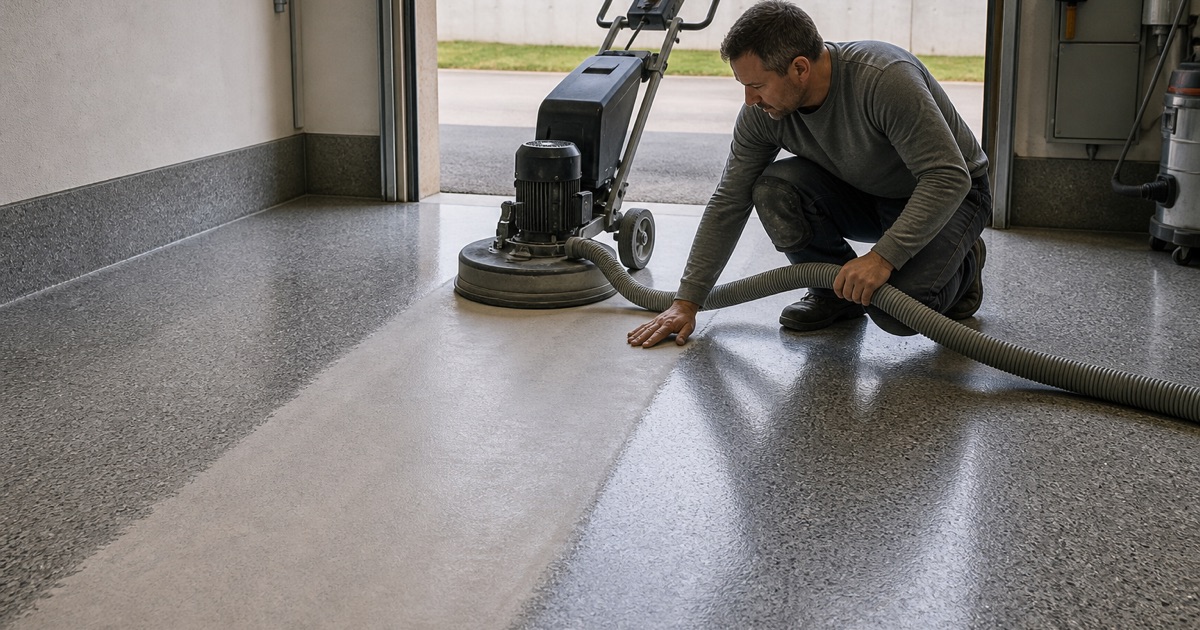
So we treat grinding as the job rather than the setup for the job. Every slab we coat is opened mechanically with a diamond grinder or a shot blaster. We do not acid etch, and we never put a new coating over an old sealer.
When a Coating Fails, the Bond Line Tells You Why
Pull up a loose piece of a failed floor and turn it over. What is stuck to the back of it says almost everything about what went wrong, and it decides how much has to come off before anything new goes down.
Peeling in Sheets With Clean Concrete Underneath
If the coating lifts in large flexible sheets and the slab beneath is bare and smooth, there was never a mechanical bond. That is the signature of a floor that was washed, etched or simply swept before coating. The old material comes off entirely; nothing bonds reliably to a coating already proving it can release.
Flaking in Patches Around Stains and Joints
Patchy failure clustered near oil spots, floor drains, joints or the base of a wall usually means contamination or moisture rather than profile. Grinding a grease-saturated area removes the surface but not what has soaked into the pores, so those zones need degreasing and a second pass before they will hold.
The Sealer Nobody Mentioned
Most slabs poured in this area were cured with a membrane-forming curing compound, and plenty of garages and patios have had a big-box sealer put over them since. Neither is visible once it has weathered. Both will defeat a new coating, and both are removed rather than coated over.
Profile Is a Specification, Not a Preference
The industry measures how open a floor is on the ICRI CSP 1-10 scale, where CSP 1 is a barely textured surface and CSP 10 is deeply scarified. The number is not a matter of taste. It is matched to the system going over it, and it belongs in the proposal alongside the product and the mil build.
Matching the Profile to What Goes Over It
A thin, self-leveling coat needs only a light profile, because too aggressive a texture will telegraph straight through a film that thin. A heavy-build epoxy or a trowel-down urethane cement wants a much more open surface with real mechanical key. Choosing the profile is therefore something we do after the system is decided, not before.
Why Acid Etching Fails Here
Acid etching is still recommended in the instructions on consumer kits, and it fails for three reasons. It cannot touch a sealer or a curing compound, so on most slabs it does nothing at all. It leaves salts and softened laitance behind that have to be neutralized and rinsed, which introduces water into a slab about to be coated. And the depth it opens is inconsistent across a floor, so parts of the slab get a profile and parts do not.
Diamond Tooling and the Bond Hardness Inversion
Diamond grinding is not one operation. The segment holding the diamonds is bonded in different hardnesses, and picking the wrong one wastes a day and a set of tooling. Getting that judgement right is what keeps a preparation quote honest rather than optimistic.
Hard Concrete Takes a Soft Bond
This is the part that reads backwards and is nonetheless correct. On hard, dense concrete you use a soft-bond segment, because the matrix has to wear away fast enough to keep exposing fresh diamond. On soft, green or sandy concrete you use a hard bond, so the segment survives long enough to do work. A crew that runs one bond hardness on every slab is polishing some floors and burning through tooling on others.
PCD Tooling for Removing What Is Already There
Old coatings, mastic, thin-set and glue residue do not come off efficiently with diamonds; they load the segments and smear. Polycrystalline diamond tooling scrapes that material off aggressively and leaves a rough, gouged surface. That pass is followed by a finer diamond pass to knock down the scoring and bring the slab to the profile the new system actually calls for.
Edges, Corners and the Perimeter
Walk into a building with a failed floor and the failure often starts at the wall. A walk-behind machine cannot reach the last inch, so edges are cut separately with a hand grinder and blended into the field. Skipping that is how a well-prepared floor still fails around its perimeter.
Grinding or Shot Blasting, and How We Choose
Both open a slab mechanically and both are legitimate methods with different strengths. Which one we bring depends on the area, the material coming off and what else is happening in the building.
Where a Shot Blaster Wins
On large open areas a shot blaster is faster and produces a uniform, aggressive profile in one pass, which suits heavy-build systems on warehouse and shop floors. It runs almost dust-free, because the machine recovers its own abrasive.
Where a Grinder Wins
A grinder is better on smaller floors, on anything with obstacles and tight corners, on soft or unsound concrete a blaster would tear up, and wherever a lighter, more controlled profile is wanted. Most residential and light commercial work here gets ground.
Dust Control in an Occupied Building
Grinding runs under vacuum with HEPA-rated dust extraction, plus containment at the openings on interior work. Silica dust is a health matter before it is a housekeeping one, and a house or a running business does not need to be evacuated for a floor.
What Grinding Cannot Fix
Preparation solves adhesion problems, and it is the single biggest lever on whether a coating lasts. What it does not solve are the two problems that most often destroy a floor in this city, and both of them sit underneath the surface rather than on it.
Water Coming Up Through the Slab
No profile stops vapor drive. On an older slab, or wherever the reading is uncertain, we test with ASTM F1869 calcium chloride, ASTM F2170 in-situ relative humidity probes or an ASTM D4263 plastic sheet test, and read the result against ASTM F710 thresholds. That testing is a line item in the scope, not something sold after a floor has blistered.
Ground That Moves Beneath It
Killeen sits on San Saba clay, a smectitic Vertisol around 50% clay with a plasticity index of 40 and a linear extensibility near 10%. Slabs on it move seasonally. Grinding cannot change that, and neither can any coating: the finished film is a few thousandths of an inch thick and follows the concrete exactly. Working cracks are routed and filled with a semi-rigid polyurea joint filler, then carried through the coating as a joint that may telegraph again.
- 20+ Years Experience
- Insured & City Registered
- Free Estimates