
Killeen Epoxy Flooring has handled epoxy floor repair in Killeen, TX for more than 20 years, serving surrounding cities including Fort Hood, Harker Heights, Nolanville, Copperas Cove and Belton. Most of the failed floors we are called to look at were installed by somebody else, and almost all of them failed for one of four reasons that the floor itself will tell you if you read it.
Repair starts as a diagnosis, not as a quote. A floor that is lifting because the slab was never opened properly needs a different answer from one blistering because water vapor is pushing up through it, and the two look similar enough from the doorway that guessing is expensive.
So the first visit is spent on the concrete rather than on the coating. We establish what the slab is sitting on, what was put down on it and how well it is still holding, and only then do we talk about whether any of it is worth saving. The ground under this city is high-plasticity clay that swells and shrinks with the season, and on a cracked floor it decides the detail more than the product does.
Reading the Peel Pattern
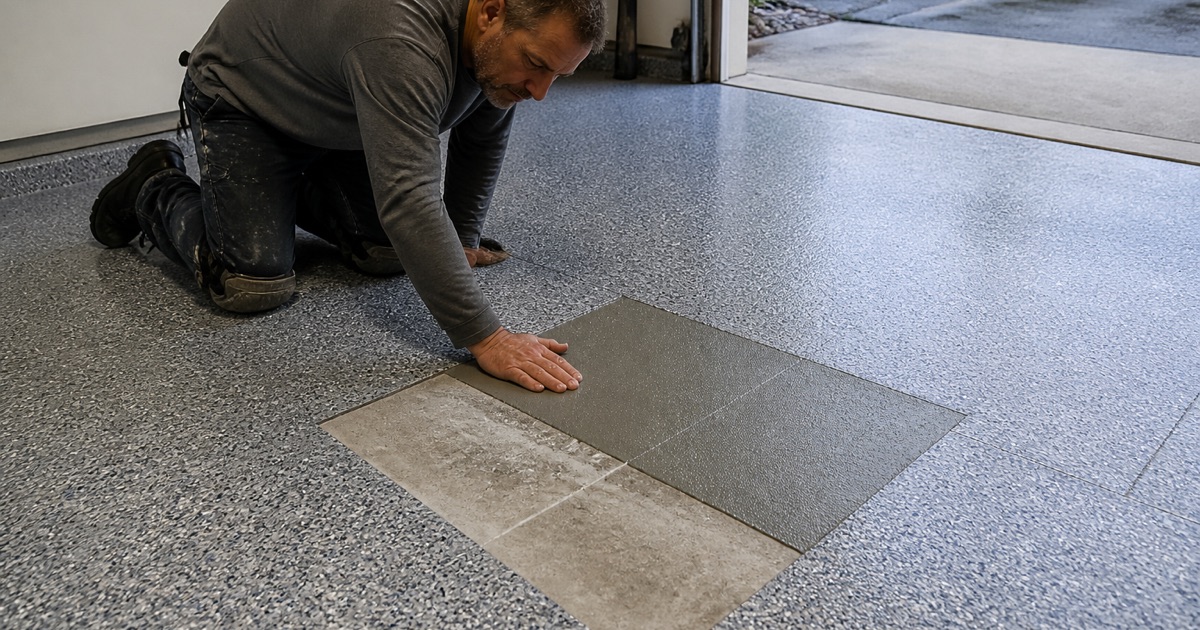
How a coating comes off is the most useful evidence on the job, and it is free to collect. Lift an edge, look at the underside, and look at what is left on the concrete.
Clean Sheets With Bare Concrete Underneath
When a coating peels in large sheets and the concrete beneath is smooth and clean, the bond never existed. The usual cause is preparation: an acid etch instead of mechanical profile, or a coating rolled straight over an old sealer or cure-and-seal. We open a slab with a grinder or a shot blaster to an ICRI CSP 1-10 profile for exactly this reason, and no repair over that slab is worth doing until the original surface is gone.
Delamination Between Coats
If the film separates layer from layer while staying stuck to the slab, the failure is between coats. Amine blush left on an epoxy base, a missed recoat window or contamination between passes will all do it. That is often the most repairable class of failure, because the primer coat below is usually sound and can be abraded and recoated rather than removed. The test is whether the remaining film still resists a blade at the edge of the failure.
Lifting in the Tire Tracks
A coating that has released in two rectangles where the car parks is hot tire pickup. Warm tires soften a thin or under-cured film and pull it off as they cool and grip. It points to inadequate mil build, a topcoat that was never rated for it, or vehicles back on the floor before full cure.
Blistering, and Why Moisture Is Usually the Answer
Domed blisters, often with liquid inside, are osmotic and they are the most common cause of adhesion failure on residential slabs in this area. Under-slab vapor retarders were not standard on older Texas pours, so the ground water underneath has an open path up through the concrete and stops at the coating.
We measure rather than assume. ASTM F1869 calcium chloride tests give a moisture vapor emission rate, ASTM F2170 in-situ relative humidity probes read what the slab holds at depth, and both get compared against ASTM F710 thresholds for the system being considered. An ASTM D4263 plastic sheet test is a quick field indicator, not a substitute for either.
On an older slab that testing is a line item in the scope from the start. It is not something we sell afterward once a floor has already blistered, and where the numbers come back high the answer is a moisture-mitigation primer built into the specification rather than a heavier topcoat hoping to hold it down.
Testing Adhesion Across the Whole Slab
A failed floor is rarely failed everywhere, and the percentage that is still bonded decides what happens next. We sound the floor across a grid, pull test in each area and map the results rather than judging from the worst corner.
That map matters because the two ends of the range have opposite answers. A floor bonded across most of its area with isolated failures can be cut back to sound material, feathered and recoated. A floor holding in scattered islands cannot, because every remaining island is a future edge, and edges are where the next failure starts.
Slab condition goes on the same map. Where the ground under a floor has moved enough that the concrete itself needs structural work, we say so and we tell you plainly that foundation repair in this city has needed its own permit since January 2022, while a floor coating needs none.
Partial Removal, Recoat, or Take It All Off
Full removal is done with PCD tooling, which shears an old coating off the slab, followed by a finer diamond pass to leave the profile the new system needs. Diamond segment bond hardness is matched to the concrete, because soft segments on a soft slab glaze over and stop cutting.
Partial removal costs less on the day and it carries a real condition. The transition between the retained coating and the new work will be visible in raking light, and the retained area brings its own history and its own remaining service life into the new floor. Nothing about the new material extends the life of what was left in place.
There is a point where repair is false economy, and we would rather name it than sell around it. When the bonded area is patchy, when the moisture numbers are above the threshold for the system on the floor, or when the existing coating is thin enough that removal costs about what preparation would have cost anyway, a full teardown and a new system is the cheaper floor over any reasonable horizon.
Patching and Color-Matching an Existing Floor
Spot repairs are honest work as long as expectations are set first. A patched area is a new coating next to an aged one, and the aged one has moved: gloss has dulled, pigment has drifted, and a repair mixed to the original color code will not match what is on the floor today.
Where a match matters, recoating a whole bay or a whole room in one pass beats patching, because a boundary at a wall or a control joint reads as intentional while a boundary in the middle of a floor reads as a repair. On a flake floor the odds are better, since chip breaks up the edge, and we keep the blend and base color on record for that reason.
Whatever the scope, the proposal names the product, the system build and the finished mil thickness, so the repair can be checked against what was quoted. Warranty exclusions are read out before the work is sold, with substrate movement and moisture named first.
- 20+ Years Experience
- Insured & City Registered
- Free Estimates