
Killeen Epoxy Flooring installs polyaspartic floor coating in Killeen, TX and the surrounding cities including Fort Hood, Harker Heights, Nolanville, Copperas Cove and Belton, and we have been putting these systems down since they became a practical alternative to a straight epoxy floor. Polyaspartic is an aliphatic polyurea, and the reason it matters here is speed and ultraviolet stability rather than marketing.
Two of its properties do real work in this market. It cures fast enough that a garage can be prepared, coated and back in service inside a weekend, which is what a landlord scheduling around a lease turnover actually needs. And because it is aliphatic it holds color under sunlight instead of ambering, so it survives on a slab that gets direct sun through an open overhead door.
What it is not is a magic single-coat floor, whatever it is sold as. Polyaspartic is thin-film chemistry with a short working time, and on most floors we use it as the wear coat over an epoxy build rather than on its own. We will tell you where a full polyaspartic system genuinely earns its cost and where it is being sold to you as a premium for its own sake.
What Polyaspartic Coating Is
An Aliphatic Polyurea, Not an Epoxy
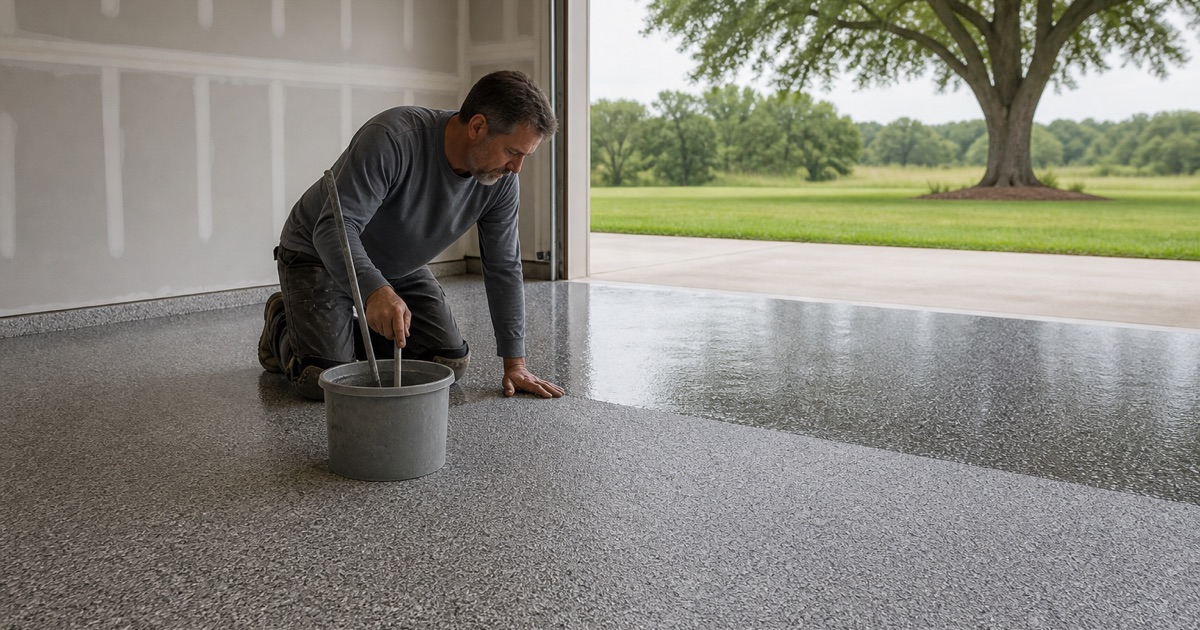
Polyaspartic is a polyurea whose cure speed is chemically slowed enough to make it sprayable and rollable rather than instantaneous. Being aliphatic means its molecular structure resists ultraviolet breakdown, which is what keeps a clear coat from yellowing. Epoxy is aromatic, harder and better at building thickness, but it ambers in sunlight — which is why most durable floors use both, each doing the job it is good at.
Cure Speed and What It Buys
A polyaspartic recoat window is measured in hours rather than the better part of a day, and return to service is dramatically faster than a full epoxy build. That is what makes a one-day or weekend garage floor possible at all. The trade-off is real: a fast cure means a short pot life and no opportunity to correct an application error, so it is far less forgiving of an inexperienced crew.
Pot Life, and Why Heat Governs It
Working time shortens sharply as temperature rises, and in a Central Texas summer an uninsulated garage slab holds heat overnight and never fully sheds it. Where a product gives roughly 40 minutes at 72 degrees, it can give around 20 at 95. That changes batch size and crew size rather than just the schedule, and it is why we mix small and work in sections rather than pouring a whole bay at once.
Where a Polyaspartic System Fits
As a Wear Coat Over an Epoxy Build
This is the configuration we specify most. A 100 percent solids epoxy carries the film thickness and bonds to the prepared slab, and a polyaspartic topcoat takes the abrasion, the ultraviolet exposure and the hot tires. It gives you the build of an epoxy and the color stability and toughness of a polyurea, and it is the combination that resists hot tire pickup best.
As a Full System on a Fast Turnaround
Where the date is the constraint — a rental turnover between tenants, a service bay that cannot be down for a week, a business coating a floor over a weekend — a full polyaspartic system genuinely earns the premium. It is the only route to a properly prepared, full-thickness floor with a same-week handover. We are explicit about what it costs against an epoxy build so the decision is yours.
On Exterior and Sunlit Slabs
Patios, pool surrounds, walkways and any bay that takes direct sun through an open door are where the ultraviolet stability stops being a specification note and becomes the whole reason to use it. A clear epoxy in that position ambers visibly within a season or two. Where the slab is outdoors we also specify texture, because slip resistance on a wet exterior surface is not optional.
Where We Would Not Use It
On a slab with a genuine moisture drive, a fast-curing topcoat does nothing about vapor pressure underneath and the floor fails at the bond line regardless. That needs a moisture-mitigation primer first, or a polished floor with no film at all. We would also not put a thin polyaspartic straight onto a slab needing significant build, because it cannot carry that thickness economically.
Flake, Color and Finish in a Polyaspartic Floor
Full Flake Broadcast Systems
The most common polyaspartic garage floor is a base coat, vinyl flake broadcast to refusal, then scraped and sealed with a polyaspartic clear. The flake hides slab irregularity and ordinary use, and the clear coat is what carries the durability. Chip size and blend change how busy the floor reads, and we show samples at floor scale rather than in the hand.
Clear Coats, Gloss and Grip
A polyaspartic clear can be finished gloss, satin or matte, and an anti-slip additive can be broadcast into it where the floor gets wet. Gloss shows tire marks and dust; satin is usually the honest recommendation for a working bay. Adding grip changes how the floor cleans, so we walk through that trade-off rather than defaulting to one.
Solid Color and Industrial Finishes
Where a plain, hard-wearing surface is wanted rather than a decorative one, a pigmented polyaspartic over an epoxy build gives a clean industrial finish that is easy to touch in later. It suits shop floors, plant rooms and back-of-house areas where the floor needs to work rather than be looked at. Color stability under sunlight is the reason to use it over a pigmented epoxy alone.
Our Polyaspartic Installation Process
Slab Testing and Preparation
Every slab is assessed, tested for moisture where its age or condition calls for it, and opened mechanically with a diamond grinder or shot blaster to the profile the system requires. Fast chemistry does not compensate for poor preparation — if anything it is less tolerant of it, because there is no long open time for the resin to wet into a marginal surface.
Crack and Joint Detailing
Working cracks and control joints are routed, filled with a semi-rigid polyurea and carried through the finished floor. Over ground with this plasticity index that step is what keeps the floor serviceable, and a fast-cure system gives no more protection against a moving slab than a slow one does.
Coating in Sections, Against the Slab Temperature
We measure slab surface temperature against the dew point before starting and work in sections sized to the pot life we actually have that day rather than to the one printed on the pail. In summer that usually means smaller batches, more hands and a mid-morning start rather than a dawn one.
Handover and Return to Service
The floor is handed over with real dates for foot traffic and for vehicles, based on the system used and the conditions it cured in. Where the job was scheduled around a lease or a reopening, we confirm those dates before the work rather than after, because on those jobs the date is as much the deliverable as the floor is.
- 20+ Years Experience
- Insured & City Registered
- Free Estimates