
Killeen Epoxy Flooring installs commercial epoxy flooring in Killeen, TX and the surrounding cities including Fort Hood, Harker Heights, Nolanville, Copperas Cove and Belton, with more than 20 years of work in kitchens, warehouses, shops, plants and clinical spaces. A commercial floor is a different job from a residential one, and the difference is not size — it is that the schedule and the specification are what is being bought.
On a garage floor the customer chooses a color. On a commercial floor somebody has to satisfy a health inspector, keep a production line running, meet a slip-resistance figure, or hand a space back on a date a lease depends on. So our commercial quotes name the system, the build, the finished mil thickness, the return-to-service and the phasing, because each of those is a term of the deal rather than a detail.
Killeen carries a wider range of commercial floors than a city this size usually does. There are ultra-pure chemical plants in the business park, aviation maintenance at Skylark Field, a school district operating dozens of kitchens and service areas, and the ordinary run of restaurants, clinics and service bays. Those want genuinely different systems, and we specify against the actual duty rather than offering one floor to all of them.
Commercial Floors by Duty
Warehouse and Distribution Floors
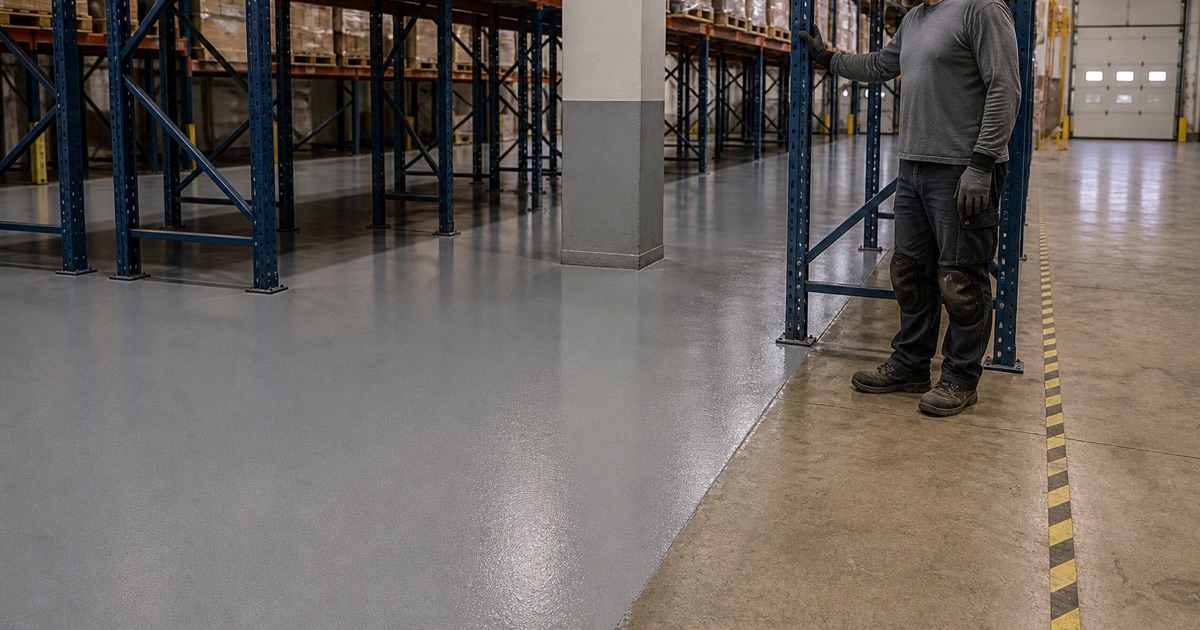
Forklift wheels concentrate load and rack feet point-load a slab, so warehouse floors are decided by build thickness and joint detailing rather than by finish. We specify a system heavy enough for the traffic and detail the control joints with a semi-rigid filler so the joint edges are supported. A warehouse coating almost always fails at its joints long before it fails in the open field.
Auto, Truck and Tire Service Bays
A service bay lives with oil, coolant, brake fluid, dropped tools and hot tires, which is a chemical-resistance problem and a hot tire pickup problem simultaneously. Full-build 100 percent solids epoxy with a polyaspartic or polyurea wear coat handles both. Drains, lift penetrations and the pit edge get detailed deliberately, because those are where a bay floor actually starts to let go.
Manufacturing and Chemical Plants
Where specific reagents are handled, general chemical resistance is not a specification and a floor sold on it is being sold on nothing. We specify against the actual chemistries on site, and in containment areas we build coved details that hold a spill rather than pass it to the next bay. Penetrations and equipment plinths are treated as part of the containment rather than as afterthoughts.
Aircraft Hangar and Maintenance Floors
Hangar floors combine very large uninterrupted areas, fuel and hydraulic exposure, and point loads from jacks and tugs. They also have to be coated around aircraft that cannot simply be rolled out for a week. We plan the phasing first and then pick a system whose recoat window fits the phasing, rather than choosing a product and discovering it cannot be sequenced.
Medical, Dental and Veterinary Floors
Clinical floors have to be seamless and cleanable with coved junctions and no crevice for anything to collect in. We install a monolithic surface with detailed edges and a topcoat compatible with the disinfectants actually in use, which is a question worth asking before specifying rather than after. A floor that cannot take the cleaning regime fails at its edges first.
Commercial Kitchens Under the Texas Rules
What the Rules Actually Require
Texas adopts the FDA Food Code by reference through 25 TAC Chapter 228. Section 6-101.11(A) requires floors that are smooth, durable and easily cleanable, and nonabsorbent where the area is subject to moisture. Section 6-201.13 requires the floor and wall juncture to be coved and closed. Those are the provisions that decide a kitchen floor specification, and they are checkable rather than a matter of opinion.
Coving, Done as a Detail Rather Than a Sealant
A coved and closed juncture means an integral coved base formed as part of the floor system, carried up the wall and sealed into it. A bead of silicone in the corner is not that, and it is the detail most often substituted. We form the cove as part of the floor because it is what the rule asks for and because it is the part that survives daily cleaning.
The Antislip Exception, Cited Properly
Operators are frequently told that a textured floor conflicts with the requirement for a smooth surface. It does not. Section 6-201.11 carries an express carve-out for antislip floor coverings or applications used for safety reasons. We specify the texture a wet kitchen actually needs and cite the exception that permits it, rather than treating a slip hazard and a compliance question as a choice between two problems.
Urethane Cement Where Epoxy Cannot Survive
Hot washdown, steam cleaning and thermal shock will take an epoxy off a slab no matter how well it was installed, because the coating and the concrete expand at different rates under a hot water hit. Urethane cement is formulated for that duty and tolerates it. In any kitchen or processing area with hot water hitting the floor daily, it is the correct system rather than the upgrade.
Getting the Approval Sequence Right
In Killeen the city issues the food dealer’s permit while plan review runs through the county health district, and plan review is required before construction begins rather than after. That sequence catches operators out and costs real time. We work to the plan that was approved, and we tell you where the floor specification is something the reviewer will want to see.
How a Commercial Job Runs
Specification and a Documented Build
We put the system, the build, the finished mil thickness and the return-to-service into the proposal, so the specification is a document rather than a conversation. On a job that has to satisfy a third party, that record is what allows what was installed to be checked against what was approved.
Phasing Around an Operating Business
Most commercial floors go in around a business that cannot close. We sequence the work in sections, contain the dust and the odor, and tell you what each section costs in downtime before starting. A fast-curing product with a long recoat window can take longer overall than a slower one, and the phasing plan is where that gets decided.
Preparation at Commercial Scale
Every slab is opened mechanically to the ICRI CSP profile the system requires, with dust collection appropriate to an occupied building. On a large floor that is the majority of the labor and the majority of the risk, and it is the line most often thinned to win a bid. We quote the preparation the system actually needs.
Scheduling Against Conditions, Not the Calendar
Slab temperature, dew point and pot life govern when material can go down, and in this climate they move a great deal between March and August. We schedule against the slab surface rather than the air temperature, and we build the phasing around the working times we will actually have rather than the ones printed on a data sheet.
- 20+ Years Experience
- Insured & City Registered
- Free Estimates